
Preventing workplace violence and harassment is essential to building a healthy, respectful work environment where everyone can thrive.
General Regulation 91-191 of the Occupational Health and Safety Act requires all provincial workplaces to develop a Code of Practice to prevent workplace harassment.
Every New Brunswick employer must also conduct a risk assessment for violence and, based on certain criteria, may also be required to develop a code of practice to prevent violence at the workplace.
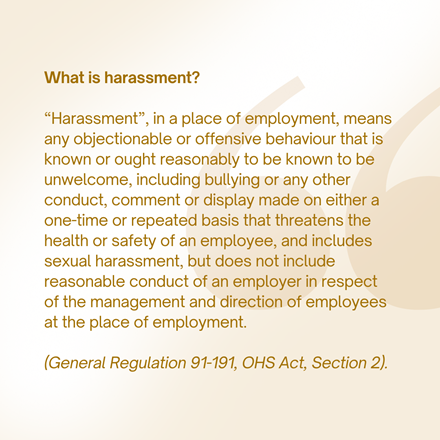
The regulation defines workplace harassment as any behaviour that is known or should be expected to be known to be unwelcome that would demean, embarrass, humiliate, annoy, alarm or threaten an employee’s health and safety. This can be on a one-time or repeated basis, and includes sexual harassment.
In every workplace, however, conflicts can arise that may be unpleasant, but do not escalate to the point of bullying or harassment. Differences of opinion or minor disagreements are not generally considered to be workplace harassment.
Actions taken by the employer to manage daily operations are considered a normal part of employment, and would not constitute bullying or harassment. This might include:
New Brunswick was one of a few Canadian provinces and territories without legislation to mitigate and prevent workplace harassment.
Stakeholders from a variety of sectors including health care, education, and retail voiced their concerns about sources of violence or harassment in their workplaces and its impact on their employees and business. Following consultation with our stakeholders, these changes to legislation were introduced as an extension of the health and safety measures all employers and workers should embrace in their workplace.
The legislation pertaining to harassment will impact all NB workplaces. Each workplace will be required to develop a code of practice to prevent and manage harassment.
When you’re hurt on the job, WorkSafeNB is there to help you get back to work and feeling like yourself again. We can provide compensation coverage and arrange for treatment.
In the case of workplace harassment, WorkSafeNB can provide compensation coverage to a worker when the incident has resulted in a diagnosable injury or illness. With violence, it may be physical, but for harassment the injury may be psychological. Compensation is available for psychological injuries when they meet the criteria of a traumatic event, which is defined as being exposed to one or more of the following: